What type of welding fume extraction method should you choose?
Determining the right welding fume extraction system depends on your welding process, production environment and exposure risks. In this article, we explain which fume extraction methods are best suited to different welding processes and when they should be combined, to ensure effective protection for operators.
The type of welding fume extraction system you need rarely depends on a single factor. The welding process, the size of the work area and the layout of the production facility all influence which solution is most suitable.
In some environments, it is sufficient to capture the fumes directly at the source. In other situations, several solutions must be combined to manage both welding fumes close to the source and those that spread further into the premises.
This means that the choice of welding fume extraction system is often more about how the work is actually carried out in practice than about the welding method itself.
When at-source welding fume extraction is the right choice
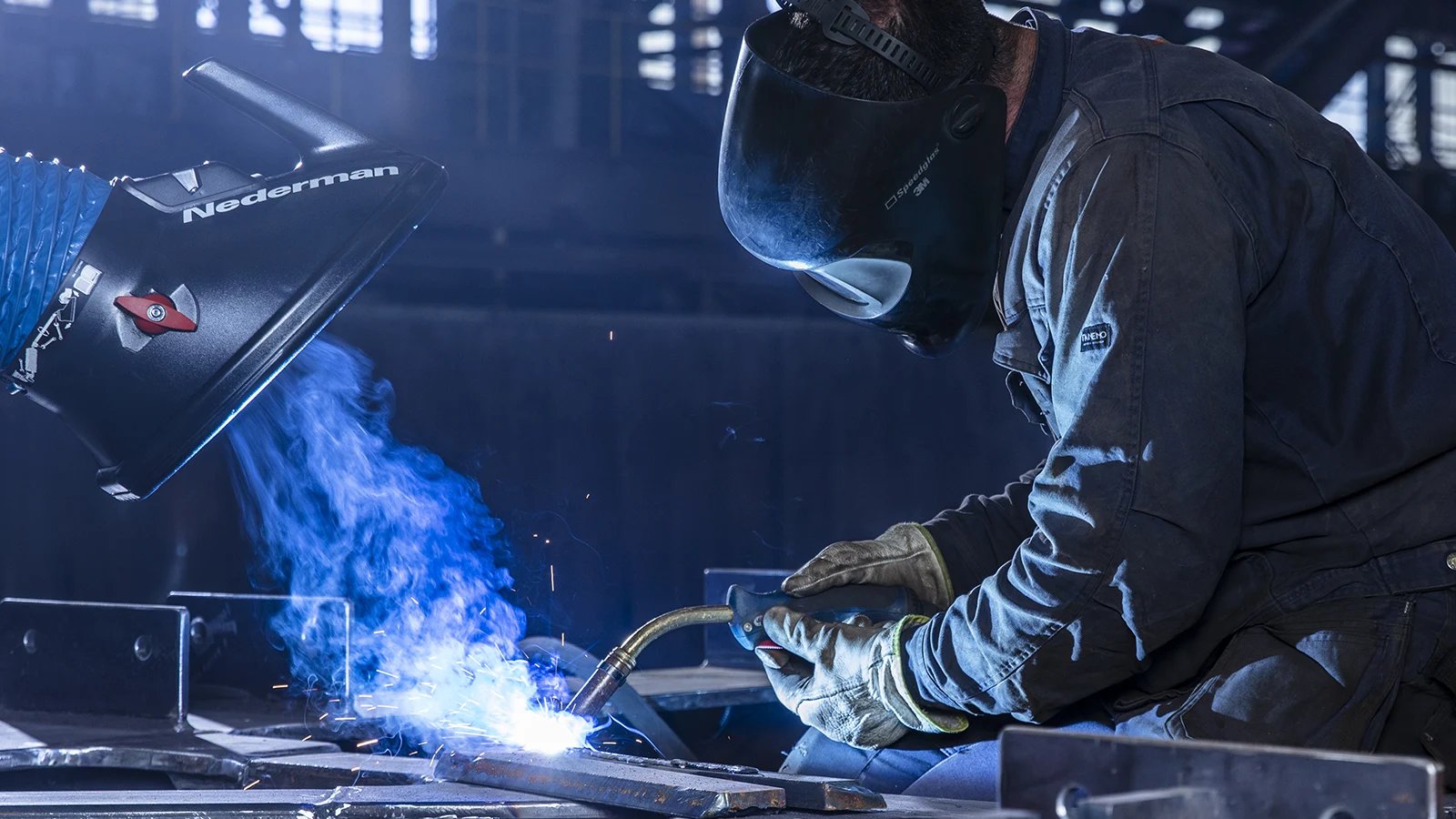
At-source extraction using a local exhaust ventilation (LEV) system is primarily used at fixed workstations where welding takes place within a confined area. An extraction arm is positioned close to the welding zone to capture the fumes at source, before they spread further into the workshop.
This type of solution often works well for manual welding tasks where the workpiece remains stationary and the operator works from the same position for extended periods. However, not all welding work is carried out at fixed workstations. In operations where work locations vary from day to day, or where it is impractical to install permanent extraction systems, mobile at-source solutions are often used. In these cases, a flexible extraction arm mounted on a mobile unit allows effective fume capture while providing the flexibility needed in dynamic production environments.
Regardless of whether the system is fixed or mobile, the effectiveness of at-source extraction is greatly influenced by how the extraction arm is positioned in relation to the welding zone. If the extraction system is positioned too far away, capture efficiency drops rapidly as the welding fumes mix with the surrounding air. For this reason, localised extraction is most effective in tasks where a stable working position can be maintained over time.
When on-torch welding fume extraction is the best method
When welding where the operator needs to move along the workpiece, it can be difficult to constantly adjust a separate extraction system. In such situations, extraction integrated directly into the welding torch is often used.
As the weld fume extraction takes place directly at the welding torch, the extraction automatically follows the work as it progresses. This makes the solution useful for longer joints, larger structures and work stages where the position changes continuously.
Integrated extraction is often used to ensure consistent extraction close to the source without the need to interrupt the work to move equipment manually. Learn more about on-torch welding fume extraction here.
When local containment is the best approach
Local containment for enclosed fume extraction is used when direct source capture is difficult or impractical due to the size of the workpiece or the way the work is carried out. Instead of capturing fumes directly at the source, the welding process is enclosed within a defined area where the fumes are extracted via designated outlets, preventing them from dispersing throughout the facility.
This method is commonly used in robotic welding applications, where consistent enclosure of the process allows for effective and controlled fume capture. Local containment is also an effective solution for welding on large components or structures. By enclosing the entire work area, fume capture can be focused within the contained zone, reducing the spread of welding fumes into surrounding production areas.
When ambient air filtration is necessary
In larger production environments, it is not always sufficient to capture welding fumes only at the point of operation. When source capture is limited by part geometry or process constraints, or when several welding stations are in use at the same time, some fumes can spread throughout the premises and affect areas further away from the actual welding.
This is particularly obvious in open workshops where air currents and movement during production allow particles to spread between different work areas.
In these environments, ambient air filtration is used as a complement to filter and circulate the surrounding air throughout the premises.
How are different types of welding fume extraction systems used in combination?
In many production environments, several types of welding fume extraction systems are used in combination. For example, a workshop might have localised extraction at fixed workstations, integrated extraction in welding torches for work tasks carried out along the workpiece, local containment for enclosed or automated welding processes, and ambient air filtration to manage the surrounding air in the premises. Mobile extraction units are often used as a supplement for temporary work or maintenance jobs.
This means that choosing a solution is rarely a matter of finding a single system that works everywhere. Instead, it is about adapting the extraction to how different work tasks are actually carried out in production.
What factors determine the choice of welding fume extraction system?
In conclusion, welding fume extraction is rarely about a single solution, but rather about understanding how welding is actually carried out in production. To determine which solution is most suitable for your process, it is necessary to consider several aspects of the working environment simultaneously.
The size of the workspace, how often the welding is moved, and how many processes are running in parallel all influence which solutions work best. The way air moves within the premises and how close the extraction system can be positioned also have a significant impact on the outcome.
Do you need to review your welding fume extraction system?
At Nederman, we cover the entire industry chain and offer fume extraction systems based on the specific nature of your production, whether for a single workstation or a more complex production facility.
Contact your local clean air expert and we’ll help you review which solutions are relevant based on the needs of your business.