Case story Exhaust extraction at Murrumbateman Rural Fire Service
Most people are quick to realise the dangers that firefighters face. Risking their lives each time they step off the fire truck into blazing infernos, but the reality is the safety of firefighters is at stake long before they don the turn-out gear and reach for the fire hose.
With appliance vehicles housed in fire stations the pervasive presence of diesel exhaust poses a significant risk to firefighters long before they’re exposed to the more obvious dangers of smoke inhalation they encounter in their roles.
The health risks associated with prolonged exposure to diesel exhaust extend beyond immediate respiratory concerns. Studies have shown that firefighters are at an increased risk of developing long-term health issues, including cardiovascular diseases and certain types of cancer, due to the toxic substances present in diesel fumes.
Read the clear air proof – Levels dropped below exposure limits
Fire Safety Innovation: Murrumbateman RFS collaborating with Nederman for a safer workplace
Grant Morey, Deputy Captain Murrumbateman Rural Fire Service, began to notice there was an issue prior to approaching Nederman.
“At the time we had an older truck that required us to turn it on to fill the tanks. While they were being filled the truck couldn’t move. Essentially that was filling the whole workspace with diesel exhaust. You could see, taste, and smell the diesel fumes within the engine bay. This is unacceptable for the safety of our firefighters,” Deputy Captain Morey explained.
Coming from a Work Health and Safety background Deputy Captain Morey began to look at options when he saw Nederman at the AFAC Conference in 2022. It was here he learnt that we offer a range of solutions that we can tailor to emergency services.
Our expertise includes designing and installing extraction systems that effectively capture and remove harmful diesel fumes and ensure a safe working environment for firefighters.
Optimising installation and design for Murrumbateman RFS Fire Station
All fire stations come with unique design and installation challenges. Buildings are often purpose made and require careful consideration of the complexities of fire station infrastructure and the need to seamlessly integrate with existing equipment.
Fortunately, our diesel fume extraction solutions allow for a completely customisable design, and we were able to ensure a purpose-built design for Murrumbateman RFS.
Deputy Captain Morey explained the process was thorough and thought out. There was ongoing collaboration between Nederman and Murrumbateman RFS to ensure they had an install that suited their exact needs. This included the need to test the air quality and effectiveness of each unit.
“The lead up to the install involved considerable time to design the unit fit for our environment. Through collaboration with Nederman, we designed a system that included one extraction system but three separate rail systems for different appliances. This will allow us to test the effectiveness of each one,” he explained.
Damian Bryant, Managing Director Nederman Australia, reflected on the collaborative success of the installation.
“We’ve donated this to the RFS here in Murrumbateman. Being able to provide the latest technology and protecting the local community has been pivotal to what Nederman is about. The aim is to be able to roll this out to every fire station in New South Wales and throughout Australia.”
Nederman’s quick-release exhaust removal system fit for emergency response
One of the key challenges encountered by emergency services and installation of diesel fume extraction systems is the requirement for a quick-release system. Response time is crucial in their operations, and they cannot afford to waste time disengaging an appliance from its extraction system when every second counts.
Our quick-release exhaust removal systems are specifically designed for fire and emergency stations. This feature addresses the need for safe and effective extraction of fumes and gases while allowing emergency vehicles to exit swiftly. This was an important component of the customised design for Murrumbateman RFS.
The installation at Murrumbateman RFS utilises a range of our products and capabilities. The pneumatic system is affixed to a Land Cruiser vehicle, utilising a compressor to secure a nozzle tightly around the exhaust, which remains in place until the vehicle departs. While the magnetic system involves an arm positioned alongside the appliances, attaching a hose to the exhaust that automatically disengages upon departure.
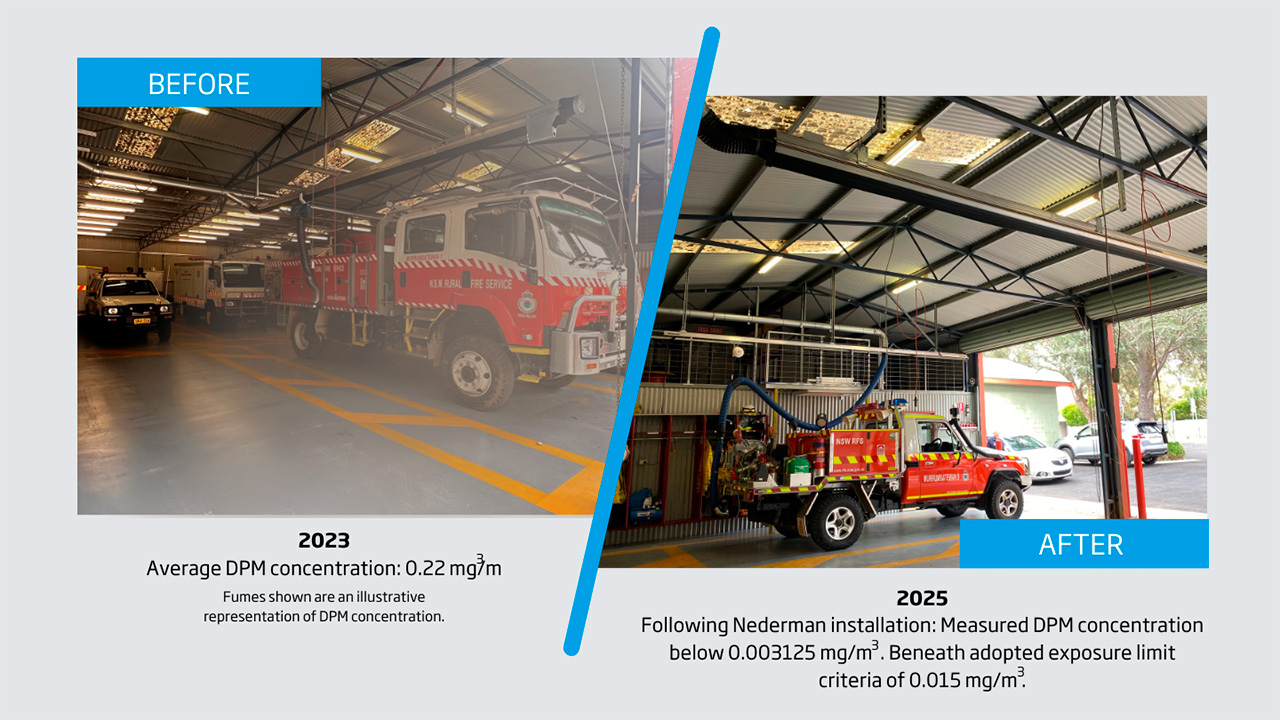
The results are clear - Diesel particulate matter (DPM) levels drop from 0.22 mg/m³ to 0.003125 mg/m³ (below detectable limits)
In June 2023, prior to the installation of Nederman’s extraction system, Murrumbateman Rural Fire Brigade, with the support of an independent occupational hygienist, Lancaster & Dickenson Consulting (L&D Consulting) conducted an air quality test at their fire station to understand and determine what the exposure levels were of diesel particulate matter which were expelled into the station environment from their fire appliances. During this testing the average diesel particulate matter (DPM) concentrations were recorded at 0.22 mg/m³, with the highest of eight sensors detected at 0.34mg/m³. This figure sat at an eye-watering level above the proposed national exposure limit of DPM concentration which was recommended to be at 0.015 mg/m³.
Following the installation of the Nederman extraction system in August 2024, and further wanting to quantify the difference our systems make, a post-implementation assessment was undertaken by L&D Consulting in March 2025. This testing confirmed the positive impact our extraction systems have had on workplace safety and firefighter health, with the level dropping from an average 0.22 mg/m³ to an impressive 0.003125 mg/m³ (below detectable limits) across all areas of the station. This is significantly beneath the, now adopted, exposure limit of 0.015 mg/m³ set by Safe Work Australia.
This result is proof of a substantial improvement in air quality. It demonstrates a strong commitment to the health and well-being of our firefighters and significantly reduces exposure to harmful diesel emissions. With our extraction systems in use, Murrumbateman Rural Fire Brigade has created a safer, cleaner working environment for its crew, and one that supports both immediate safety and long-term occupational health of our heroes.
Ongoing commitment to cleaner air for our emergency responders
Deputy Captain Morey hopes that our products will be rolled out into other RFS fire stations throughout the state.
“The collaboration with Nederman has been a positive experience. We are eager to share our findings and promote this safety initiative within the broader service.”
He noted that the customisation could benefit other fire stations, “the units from Nederman allow for customisable units for each station’s requirements. That makes them very beneficial to our specific industry where we all have individual needs.”
By providing advanced solutions for diesel exhaust extraction, we not only mitigate immediate health risks associated with harmful fumes but also pave the way for a cleaner and safer working environment for our Australian firefighters. As the importance of air quality and occupational safety continues to gain recognition, we look forward to creating healthier and more sustainable emergency service operations and cleaner air for all our emergency responders.
Contact your local clean air expert to find the right solution for your fire station.