Mass Timber Dust Collection: Designing for Safer, More Efficient Production
Mass timber is becoming an increasingly important part of modern construction. Engineered wood products such as cross-laminated timber (CLT), glue-laminated timber (glulam), nail-laminated timber (NLT) and dowel-laminated timber (DLT) combine the sustainability benefits of wood with the scale and precision of modern industrial production.
Manufacturing these large structural panels, beams and components also creates a significant dust and material-handling challenge.
Cutting, routing, sanding, drilling and CNC machining can generate everything from fine airborne dust to large quantities of chips and shavings. In high-production facilities, that material must not only be captured and filtered effectively, but also transported, stored and removed without becoming a constraint on production.
For mass timber manufacturers, effective dust management therefore extends well beyond the dust collector. Airflow and material flow must work together—from the production process through final waste handling.
Why mass timber creates a different dust collection challenge
Mass timber plants often operate differently from traditional woodworking shops. Large-format components are processed on high-powered automated equipment, frequently through several machining operations and at high production rates.
Common dust- and chip-generating processes can include:
- CNC machining of CLT and glulam components
- Sawing, routing and edge profiling
- Automated drilling and fastening preparation
- Surface preparation and sanding
- Robotic machining and finishing
- Material transfer and handling
- Cleanup and maintenance activities
The type and quantity of material can vary considerably between processes. One operation may generate relatively fine dust while another produces significant volumes of chips and shavings.
These differences influence source capture, duct transport, filtration and the equipment needed to move and manage collected material downstream. A successful system therefore needs to account for both the air required to capture dust and the volume of material that production can generate.
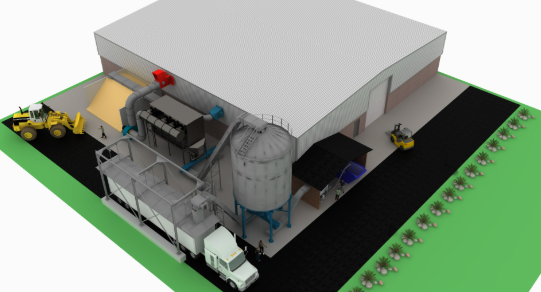
Know the material you are handling
Wood dust characteristics can vary with species, moisture content, engineered wood composition and machining process. Particle size and density can influence material transport, filtration and combustible-dust considerations.
For unfamiliar materials or processes, testing can help reduce assumptions during system design. Nederman's Combustible Test Analysis services can include particle-size analysis, density testing and combustible-dust screening to help identify appropriate next steps when additional evaluation may be required.
Capture dust and chips at the process
Effective dust control begins as close to the source as practical.
Mass timber facilities may require extraction at CNC machines, routers, saws, drilling stations, sanding equipment and automated or robotic processes. Capture systems need to account for both the airflow required at the machine and the type and quantity of material entering the system.
High-vacuum extraction can also support applications such as robotic sanding, on-tool extraction and localized processes where capturing fine dust directly at the tool is beneficial.
Effective source capture can reduce airborne dust, limit migration through the facility and reduce secondary cleanup. But in a high-production mass timber plant, collecting the material is only the first part of the challenge.
Material handling is part of the production process
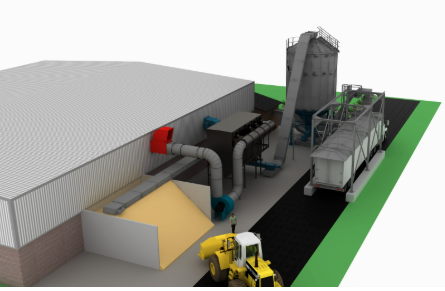
Once dust and chips are separated from the airstream, they still need to be moved away from the collector and ultimately reused, recycled or removed.
This is particularly important in mass timber manufacturing because CNC machining and other processes can generate substantial and sometimes rapidly changing volumes of wood waste. A filtration system may have sufficient airflow capacity, but production can still be affected if the collected material cannot be discharged and transported reliably.
Depending on the facility, downstream handling may incorporate rotary airlocks, screw or chain conveyors, storage silos or bunkers, briquetting equipment, truck-loading systems and other mechanical handling equipment.
For heavy-duty applications, the capacity and robustness of this equipment matter.
Mechanical systems such as chain conveyors can provide a dependable way to continuously move high volumes of chips, shavings and dust between filtration, storage and final discharge. Conveying capacity should account for expected production peaks—not simply average material generation.
A restriction or failure downstream can eventually become an upstream production problem. If material cannot leave the collector or move through the conveying system reliably, operations may need to slow or stop even though the filtration equipment itself is functioning properly.
For that reason, material handling should be treated as part of the production-support system rather than as an accessory added after the dust collector is selected.
Storage creates a buffer between production and waste removal
Production and waste removal rarely operate at exactly the same rate.
Certain machining cycles, production runs or shifts may generate large amounts of material over a relatively short period. Trucks, containers, recycling operations or other downstream processes may operate on a different schedule.
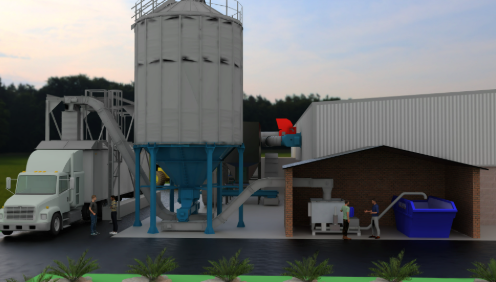
A properly sized storage silo can provide an important buffer between these activities. Instead of requiring wood waste to leave the facility at the same rate it is produced, the silo allows material to accumulate temporarily and then be discharged on a more controlled schedule.
This can help:
- Absorb short-term peaks in material generation
- Reduce dependence on precisely timed trucks or containers
- Allow waste removal or material transfer to occur on a planned schedule
- Provide flexibility when production rates vary by shift or product
- Reduce the likelihood that downstream logistics will interrupt machining operations
In this way, storage is not simply about holding wood waste. It can help decouple production from downstream logistics.
For example, a temporary surge from a CNC line can be absorbed by available silo capacity rather than requiring every downstream process to immediately handle the same peak. Stored material can then be discharged at a rate better suited to truck loading, recycling, briquetting or another final destination.
The same buffer can provide flexibility when a truck is delayed, a container is being changed or downstream material use temporarily slows.
For high-throughput mass timber operations, evaluating conveying capacity, storage volume and discharge rates against both normal and peak production conditions can therefore be an important part of maintaining continuous operation.
Design with the complete system in mind
In high-volume mass timber manufacturing, the individual parts of a dust and material-handling system do not operate independently. Decisions made in one area can affect performance elsewhere, particularly as production volumes and operating conditions change.
Taking a system-level approach allows airflow requirements, material loads, production peaks, storage capacity, controls, maintenance access and future expansion to be considered together during design.
This becomes increasingly important as facilities grow in size and complexity. Adding production equipment, for example, may affect both extraction demand and the amount of material that must move through downstream handling equipment. Increased production may also change the amount of buffer storage required or the rate at which material needs to be discharged.
There can also be practical advantages to working with a supplier capable of coordinating the overall system. Reducing interfaces between separate equipment providers can simplify engineering, installation and commissioning while creating clearer responsibility for how the system performs as a whole.
For mass timber manufacturers, where dust extraction and material movement are closely tied to production availability, an integrated approach can help create a system that is easier to operate, maintain and adapt as production needs evolve.
Housekeeping remains part of the system
Even effective source capture cannot collect every chip or particle generated in a high-production mass timber facility. Heavy machining, material handling and maintenance activities can leave dust and wood waste around production equipment and throughout the plant.
A practical housekeeping strategy helps remove this material before it accumulates while also making machinery easier to inspect and maintain. Central high-vacuum systems, strategically located vacuum points and hose reels can provide convenient cleanup around CNC equipment and other areas where material regularly collects.
Housekeeping should therefore be considered part of the overall dust-management and equipment-maintenance strategy—not simply a cleanup activity.
Treat combustible dust as a complete-system risk
Wood dust can present a combustible-dust hazard under certain conditions, making combustible-dust evaluation an important consideration in mass timber manufacturing.
The appropriate protection strategy depends on the dust, the process, the equipment configuration and applicable codes and standards. Importantly, combustible-dust risk is not limited to the filter itself.
An evaluation may need to consider ductwork, ignition sources, explosion protection and isolation, material discharge and conveying equipment, storage, grounding and bonding, housekeeping, inspection and maintenance.
No individual collector or protection device automatically makes an installation compliant.
Considering combustible dust across the complete system helps manufacturers and their engineering partners understand how individual components interact and where appropriate safeguards may be required.
Use controls and monitoring to support performance
Large mass timber facilities may have many connected machines that do not all operate simultaneously. Variable frequency drives, automatic dampers and intelligent controls can help align extraction airflow with actual production demand.
Nederman SAVE technology can use machine operating status to adjust extraction demand as production changes. When properly engineered, this can help reduce unnecessary fan energy use and conditioned-air loss while maintaining the airflow needed for effective capture and material transport.
Operational visibility is also important because filtration is only one part of the system.
Fans, filters, rotary airlocks, motors, conveyors and other critical equipment may all need to operate correctly for production to continue reliably. Depending on the system configuration, connected monitoring can provide information about filtration performance as well as selected equipment within the material-handling process.
This broader view can help maintenance teams identify developing issues beyond the dust collector itself. A downstream conveyor or rotary airlock problem, for example, may eventually affect the entire process if it is not addressed.
Nederman Insight can provide a platform for making system information more accessible to operations and maintenance personnel, supporting maintenance planning and long-term performance.
A complete approach to mass timber dust and material management
Mass timber manufacturing requires more than high-performance production machinery. The dust, chips and wood waste generated by those machines must continue moving reliably through the facility without becoming a constraint on production.
Robust conveying equipment can handle heavy material loads. Storage silos can provide valuable buffer capacity when production and waste removal operate at different rates. Effective housekeeping supports clean, maintainable equipment. Appropriate controls and monitoring provide greater visibility into the system, while combustible-dust considerations must be addressed across the complete installation.
The common thread is integration.
Rather than treating dust collection, conveying, storage and waste handling as separate projects, considering them as one production-support system can simplify interfaces and help manufacturers maintain reliable operation as production demands change.
Nederman's experience across extraction, filtration, material handling, controls and monitoring enables these elements to be coordinated through a common system approach—helping mass timber manufacturers keep both air and material moving reliably from production through final waste handling.