Building the Future of Mass Timber: Nederman’s Integrated Dust Collection Solutions
Sawdust like fine flour. Thick, fluffy planer shavings. Chip mixed in, and slivers. Kalesnikoff's mass timber plants produce all of it at once, in volume, into the same ductwork.
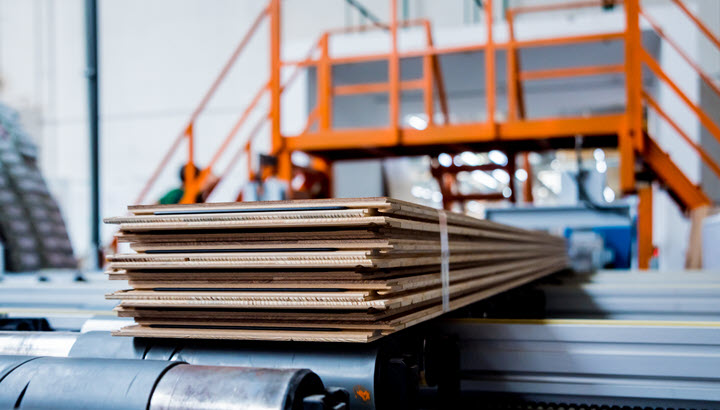
That is what a sawmill's byproduct becomes once the company moves into mass timber: cross-laminated timber panels and glulam beams and columns, machined to finished dimensions and shipped ready to lift into place. Two dust collection systems failed to handle it before Nederman.
Four Generations, Fully Integrated
Kalesnikoff has been climbing the value chain for four generations, and Chris Kalesnikoff, President and Chief Executive Officer, tells the progression in a sentence. "Our great-grandfather and his brother started the business logging by horseback. Our grandfather grew the business into a sawmill, and our father further grew it into value added products." That was 1939, in British Columbia's West Kootenays.
Chris and his sister Krystle Seed, the fourth generation, took the next two steps. "We built on that legacy by growing our vertically integrated forestry business into mass timber and now into construction," Chris says. The company now stands out as North America's most advanced, vertically integrated, multi-species mass timber manufacturer. It runs the entire chain, from woodlands to sawmill to mass timber to modular assembly.
That growth has meant sustained hiring in a region where most forestry news runs the other way. "We've gone from a company that had 150 jobs to one that had over 300," says Krystle, the company's Chief Financial and Strategic Services Officer. With the third plant open and staffed, the payroll now runs past 400.
Zach Zimmer has watched most of that from the inside. Now Maintenance Manager, he joined the sawmill twenty years ago and put his hand up for the mass timber project while it was still drawings. "There's so much automation in this plant," he says. "Being a tradesperson myself, it was very exciting being at the forefront of a lot of the state-of-the-art equipment."
A Market Growing About as Fast as the Code Allows
Mass timber is easy to sell and harder to supply. Exposed wood looks better than the alternatives, and the carbon math favors it over concrete and steel.
It suits the west coast structurally too. "Lumber itself is a lot more flexible than rebar and concrete," Zach notes, which counts in seismic country.
The real constraint has been regulatory, and it keeps loosening. Zach has watched the height limit rise twice since the plant opened. "When we started, the BC government allowed us to build up to six stories. Since we've opened, they expanded that to 12 stories high, and now they've expanded it further. So now we can build 18-story facilities with our product."

Kalesnikoff has invested roughly $65 million across two expansions to meet that demand. In June 2025 it opened the Modular and Prefabrication facility in Castlegar, North America's first modular mass timber facility. Chris puts its purpose plainly: "We built this building so we could build buildings."
The Modular and Prefabrication facility turns the company's own timber into volumetric modules and panelized assemblies, prefabricated with electrical, heating, plumbing and digital services already fitted, for schools, student housing, multi-family residences and commercial buildings. Modules are built while site preparation runs in parallel. "Once our product arrives, it goes together like building blocks," Chris says. "Speed of construction isn't just a bonus, it's a key metric for success."
Higher Value, Harder Byproduct
The further a wood products company climbs the value chain, the more difficult its leftovers become.
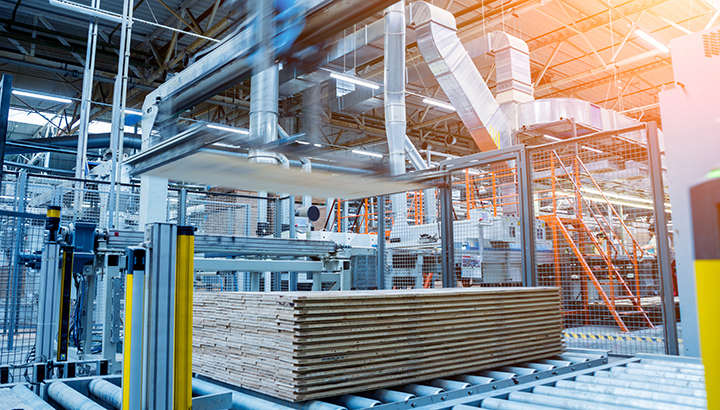
A sawmill's residue is reasonably uniform. Machining finished panels and beams is not. CNC processors, beam saws and sanders each throw off something different, and all of it lands in the same ductwork.
"It's not just flour. It's not just shavings. There's a real variety there," Zach says.
Then there is sheer volume. The mass timber facility has run 20 hours a day Monday through Thursday and 12 hours across the weekend. The beam CNCs at the Modular and Prefabrication facility run seven days.
Wood dust at that concentration is also a recognized combustible hazard, and in British Columbia it carries particular regulatory weight.

When Collection Can't Keep Up

Kalesnikoff Mass Timber (KMT) was a first-of-its-kind facility producing a byproduct mix nobody had specified a system for and each round taught Kalesnikoff what to ask for.
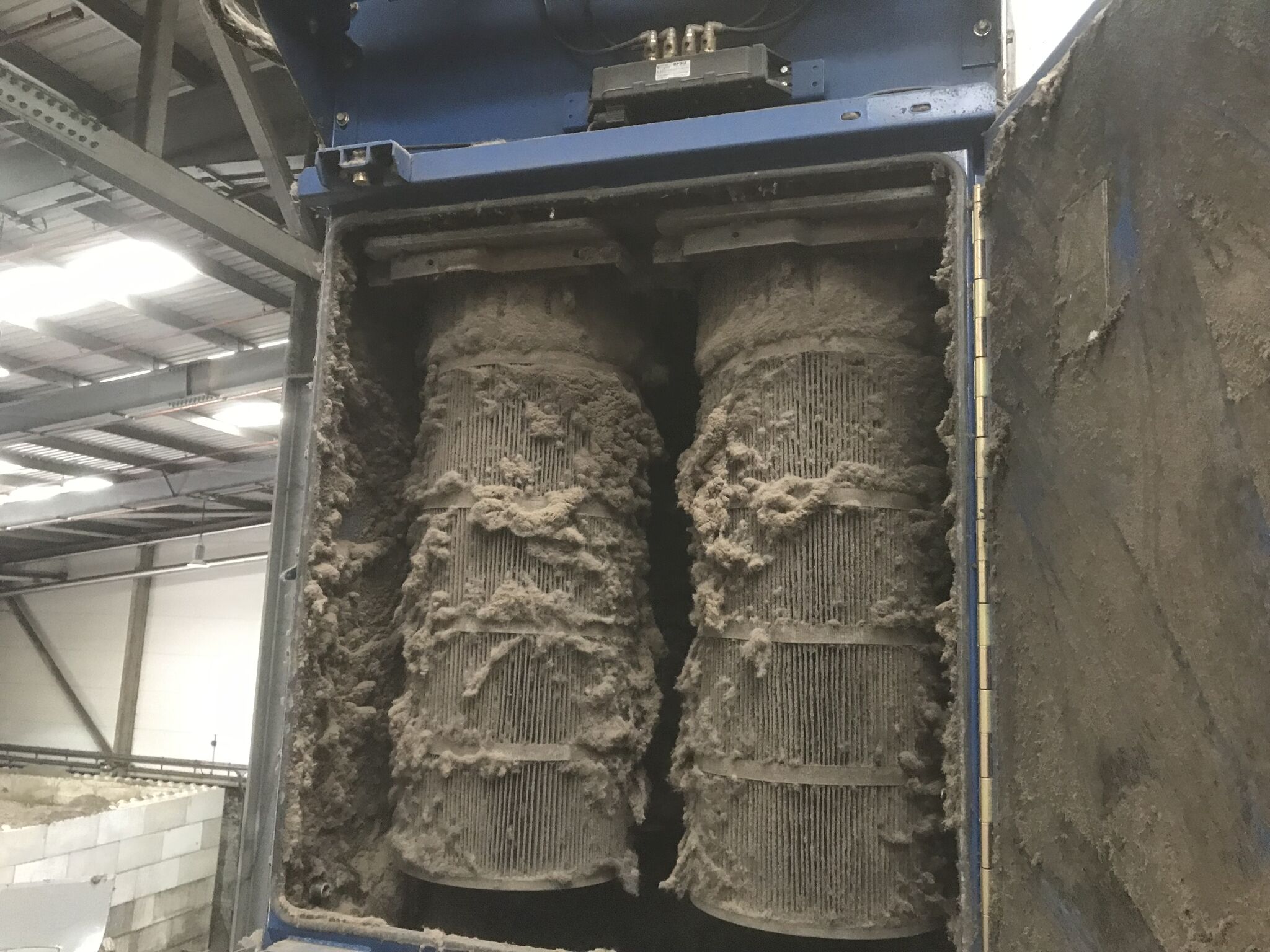
The initial remedy was manual, and it became a recurring headache. "Every two weeks, we would pull the filters out, blow them out, put them back in," explained Zach.
A second supplier replaced those units and performed considerably better, without solving it. Surge volume knocked the drag chains off their sprockets, and a rotary valve mounted perpendicular to the waste conveyor could not clear product fast enough. Zach engineered a workaround, purchasing additional rotary valves and installing them in line to raise discharge capacity.
Two suppliers in, he knew exactly what to look for.
What Clean Actually Looked Like
With the Modular and Prefabrication facility in planning, Kalesnikoff needed a collection system appropriate to a state-of-the-art facility, and that meant looking well past what it had already bought twice. Zach arranged to tour four Nederman installations in the Vancouver area with the Nederman team. None was an exact match for what the Modular and Prefabrication facility would require, but together they gave him a clear read on how the equipment behaves in production.
"What I really noticed was the cleanliness of the systems, almost immediately," he says. "Unlike any kind of industrial setting I'd ever seen."
He means that specifically. What caught his eye was outside the building, where collected material transfers into the bin. That transfer is where systems leak, and leaked material is fuel on the ground, a housekeeping burden, and the first thing a visitor notices on a site that hosts customer tours.
Solving the Discharge
The detail Zach cares about most is how material leaves the filter. Nederman's hopper feeds a rotary valve running its full length, rather than a drag chain gathering material toward a single undersized airlock. Zach points to "that rotary valve going the full length of the hopper" as the change that mattered. It takes the entire falling curtain of material, flour and shavings together, instead of asking one point to keep pace with all of it.
One design decision removes both failure modes he had worked around for years: no drag chain for surge volume to knock off its sprockets, and no discharge point undersized for the load.
One Source, One Integrated Package
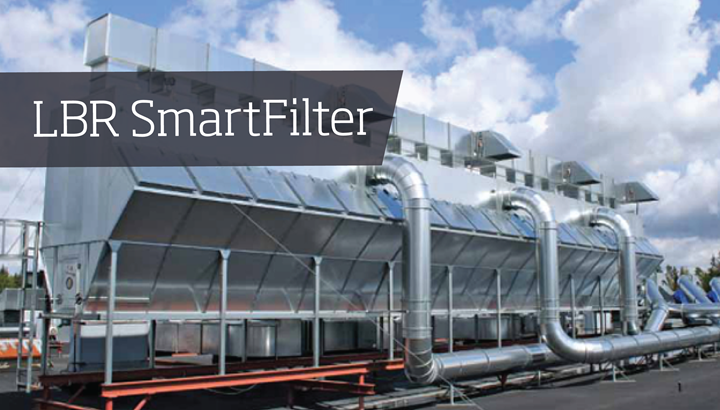
Nederman supplied the Modular and Prefabrication facility with an LBR-R-SB SmartFilter dust collector configured with a rotary valve package at 22,500 cfm, a material handling transfer system, CARZ explosion isolation flap valves and Nordfab ducting.
The filter answers the failure that defined the first system. The LBR is a reverse-air baghouse rather than a cartridge unit, running Nederman's SUPERBAG media, cleaned module by module by reversing the airflow and rated to cope with varying loads across a wide range of material. Bag life runs five to seven years, and carbon fibre woven through the media carries static away instead of letting it build.
Explosion protection is designed in rather than bolted on. The CARZ valves sit passively open while the system runs. A pressure wave from the filter forces the flap shut and locks it, stopping a flame front from travelling back down the duct into the plant. They are certified to EN 16447 and NFPA 69, and they need no power and no operator.
Sourcing all of it from one vendor mattered as much as any individual component, because accountability for how the parts work together sits in one place. "That was very appealing to me," Zach says. The components arrived engineered to fit one another, and neither system has given him an integration problem since.
A dedicated system for the finest fraction
A second Nederman system followed in 2025 at KMT, addressing the quality of Kalesnikoff's byproduct rather than a problem inside the plant.
The Costa panel sander produces the finest material in the operation, what Zach calls "absolute flour." Blended into the general byproduct stream, it changed how the whole mixture behaved: more powdery, harder to handle and transport. The customer buying that byproduct objected to how much of it was fine dust.
Kalesnikoff could have tied the new collector to a CNC. Nederman recommended dedicating it to the sander instead, isolating the fine fraction into a stream of its own and handling it with a system built for it.
The byproduct customer receives a cleaner, more consistent product. Kalesnikoff gains control of the ultra-fine fraction for reuse or alternative outlets. And the mixed-material systems no longer carry a dust that behaves nothing like the shavings and chips around it.
Installed In-House
Kalesnikoff installed both systems with its own crew. Nederman offered contractors; the team wanted the work.
"This was the first large ducting project that we had taken on," Zach says. "Our team did a fantastic job of the install."
Arriving as one designed package made that practical. Nordfab's Quick-Fit ducting clamps together with no welding, riveting or screwing, so the crew assembled runs rather than fabricated them, and the same clamps come apart again in a plant that keeps adding machines. Zach laid the system out from his own measurements, with Nederman's engineering team available throughout.
By the second installation the process had become routine. "That was our most seamless install," Zach says.
The Results
A visibly cleaner operation. What impressed Zach on the Vancouver tour of Nederman installations is what he now runs at his own sites, at the transfer point where the previous systems leaked. Contained material doesn't settle on floors, accumulate as fuel, or drift across the yard.
Reliable across the full range. The systems take everything the CNCs, saws and sanders produce, at full volume, without bridging or plugging, and both commissioned without the fight the earlier installations demanded.
Maintenance the team stopped thinking about. Nobody pulls and blows out filters anymore. "They're happy that they're not climbing around blowing out filters," Zach says. "They've moved on to other things."
Clean Through the Whole Chain
A clean production environment belongs to the same tradition of stewardship that has guided four generations of this family, from the woodlands it manages itself, through the sawmill, into mass timber and modular assembly. Krystle traces the philosophy to her great-grandfather: "Take care of the land and the land will take care of you. Take care of your community and your community will take care of you. Take care of your employees and your employees will take care of you."
Dust collection touches each of those. The workplace is cleaner, and the people who once spent hours inside filter housings are doing better work. The byproduct is cleaner, sorted rather than blended, and worth more to the customer who buys it. What used to escape at the transfer point stays contained.
That last point carries further here than it would in most industries. Mass timber's case rests on the material itself, "one of the strongest and most renewable resources on the planet," as Chris describes it. It is also how construction moves toward a low-carbon future: set against concrete or steel, sustainable wood products produce far less CO2 while absorbing and sequestering carbon from the atmosphere.
A company building that argument should be able to account for every log it touches, down to the sawdust.
"The way that we manage our land base is progressive, and it's something that we do for generations, not for short term," says Chris Kalesnikoff. Eighty-seven years on, the company that started with horses on a mountainside is making panels for eighteen-story buildings. The principle hasn't changed. Only the scale of what has to be handled cleanly.